

Head of Decarbonisation Solutions
10 min read


The NHS Evergreen assessment is the self-assessment tool the NHS uses to measure supplier sustainability maturity. From 6 April 2026, any supplier tendering for NHS Supply Chain contracts must have reached Evergreen Level 1 by the point their tender closes. Below is what Level 1 requires, how it's scored, and how to get there.
What is the NHS Evergreen Sustainable Supplier Assessment?
The NHS Evergreen Sustainable Supplier Assessment is a self-assessment and reporting tool hosted on Atamis, the NHS's commercial e-procurement platform. It replaced the older Carbon Waste and Water Reduction Assessment (CWW).
Any organisation providing, or planning to provide, goods or services to NHS England, or an NHS trust in England can complete it. NHS England recommends completing it annually, and a submitted score stays valid for 12 months.
Evergreen sits alongside four other supplier obligations that NHS Supply Chain groups together as the "Five Supplier Asks": a Carbon Reduction Plan, Social Value commitments, the Evergreen Assessment itself, Horizon Scanning, and Modern Slavery Prevention. Reaching Evergreen Level 1 doesn't reduce or replace the other four; it's an additional gate, not a substitute.
When does Evergreen Level 1 become mandatory?
From 6 April 2026, all suppliers submitting tenders to NHS Supply Chain must have achieved Evergreen Level 1 at the point of tender close, according to NHS Supply Chain's announcement from 26 February 2026.
This is a meaningful tightening. Previously, NHS Supply Chain accepted any Evergreen submission level, including the lowest. Since April 2026, submitting the assessment isn't enough on its own; suppliers need to actually clear the Level 1 bar.
Two situations already treat Evergreen Level 1 as a hard tender requirement: new NHS Supply Chain Frameworks, and NHS England Medicines tenders, which have required it since January 2024 under PPN 002's social value alignment. Since April 2026, that requirement extends across NHS Supply Chain tendering more broadly.
Why is the NHS doing this?
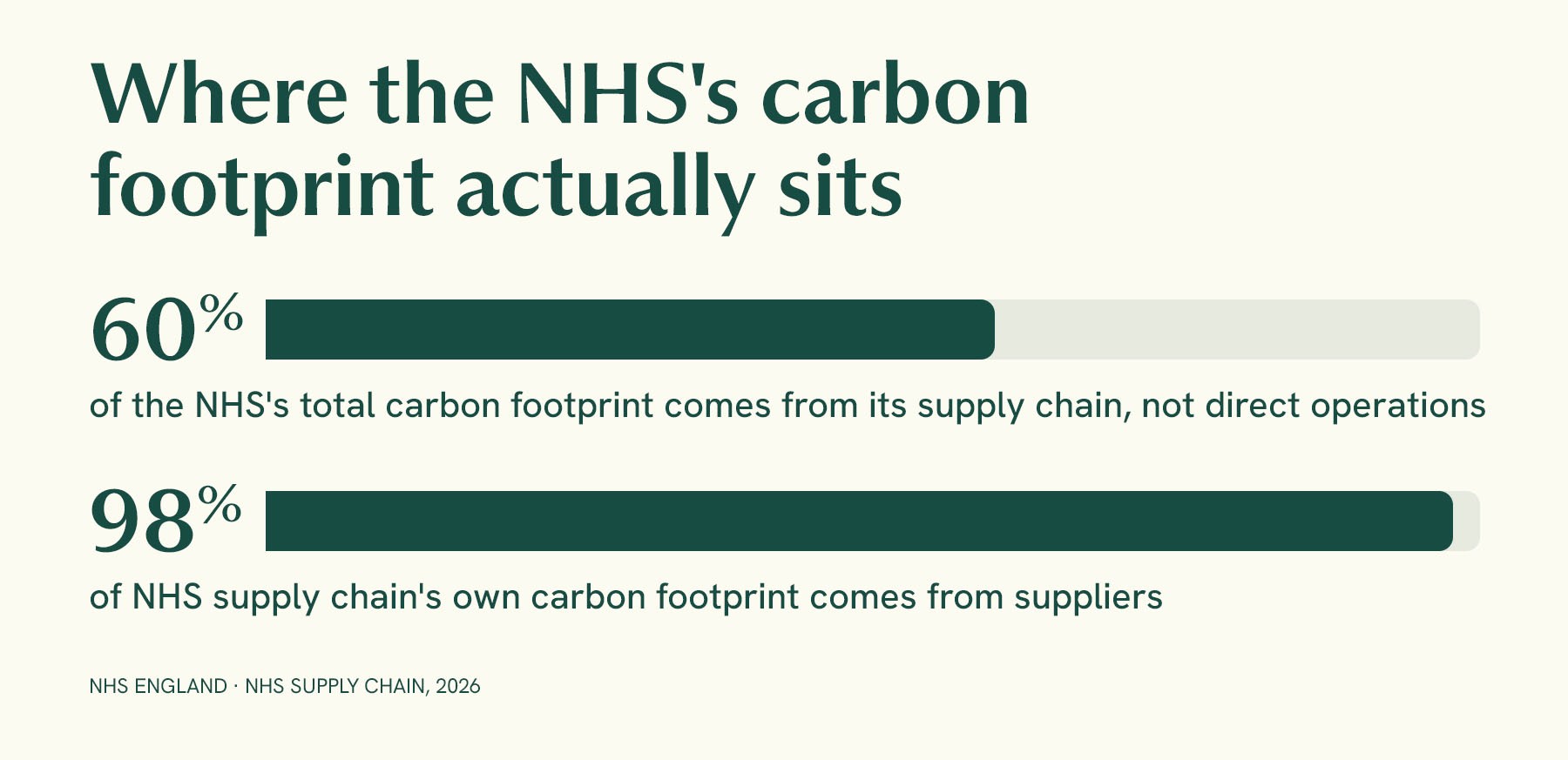
The scale of the supply chain's carbon footprint is the driver. More than 60% of the NHS's total carbon footprint, and 98% of NHS Supply Chain's own footprint, comes from its supply chain rather than direct NHS operations.
The NHS has set net zero targets of 2040 for emissions it directly controls, and 2045 for the wider NHS supply chain (its Scope 3 emissions). Suppliers are, by definition, the largest lever available to hit that second target, which is why Evergreen has moved from optional reporting to a mandatory gate.
What are the Level 1 requirements?
To reach Evergreen Level 1, a supplier needs three things in place:
A public commitment to net zero by 2050 or sooner.
A published, PPN 006 (formerly PPN 06/21) compliant Carbon Reduction Plan (CRP).
Disclosure of UK Scope 1, Scope 2, and relevant Scope 3 greenhouse gas emissions.
The full Level 1 criteria, as set under the April 2026 framework, specify:
A UK-only geographic boundary for reported emissions, not global.
Emissions measured against the GHG Protocol Standard.
A 2050 minimum net zero target year.
Board or director-level approval of the Carbon Reduction Plan.
No independent third-party validation or verification required at this level.
Modern slavery compliance limited to standard legislative requirements, not the full Modern Slavery Assessment Tool used at higher levels.
Level 1 is deliberately the entry tier. It does not require global emissions reporting, independent verification, or full social value and modern slavery compliance; those requirements are reserved for Levels 2 through 4.

How does Evergreen relate to the Carbon Reduction Plan (PPN 006)?
This is where suppliers most often get confused, because the two requirements overlap but aren't identical.
PPN 006 is the government-wide Procurement Policy Note that sets out what a compliant Carbon Reduction Plan must contain. It applies across major government contracts, not just NHS ones. Evergreen Level 1 requires a CRP that meets the PPN 006 (formerly PPN 06/21) standard as one of its three components, alongside the net zero commitment and emissions disclosure.
In other words, a PPN 006-compliant CRP is necessary for Evergreen Level 1, but Evergreen Level 1 asks for more than the CRP alone: it also requires the public net zero commitment and the emissions disclosure to sit alongside it, submitted through the Atamis platform.
A compliant CRP itself must include:
Emissions figures for Scope 1, Scope 2, and selected Scope 3 categories.
A clear, stated net zero commitment.
Board or director-level approval.
Annual updates.
Publication on the supplier's own website.
NHS Evergreen Assessment vs. Carbon Reduction Plan (PPN 006)
NHS Evergreen Assessment | Carbon Reduction Plan (PPN 006) | |
|---|---|---|
What it is | A maturity self-assessment submitted via Atamis, scored across four levels | A standalone document setting out a supplier's emissions and net zero commitment |
Who needs it | Suppliers tendering for NHS Supply Chain contracts and related NHS tenders | Suppliers bidding for major government contracts subject to PPN 006, including NHS ones |
Scope covered | UK Scope 1, 2, and relevant Scope 3 at Level 1; expands at higher levels | Scope 1, 2, and selected Scope 3 categories, as defined by PPN 006 |
Mandate date | Level 1 mandatory from 6 April 2026 for NHS Supply Chain tenders | Already required wherever PPN 006 applies; a compliant CRP is a component of Evergreen Level 1 |
Validation | No independent verification required at Level 1 | No independent verification required; board-level approval only |
What are the four Evergreen maturity levels?
Evergreen scores suppliers across four levels, each raising the bar on scope, target year, and verification.
Evergreen maturity levels (April 2026 criteria)
Level | Net zero target year | Emissions boundary | Verification | Modern slavery requirement |
|---|---|---|---|---|
Level 1 (Entry) | 2050 minimum | UK only, Scope 1, 2 and a subset of Scope 3 | Not required | Standard legislative compliance only |
Level 2 | 2050 minimum | Global boundary, Scope 1, 2 and all relevant Scope 3, aligning to the April 2027 Net Zero Supplier Roadmap | Not required | Standard legislative compliance only |
Level 3 (Established) | 2045 | Global boundary, Scope 1 to 3 | Independently validated for the reporting entity | Modern Slavery Assessment Tool completed; public statement required |
Level 4 (Advanced) | 2045 | Global boundary, reporting entity and global parent | Independently validated across the whole global organisation | Actively mapping supply chain and mitigating modern slavery risk; higher-performer transparency reporting (e.g. CDP, EcoVadis, B Corp) |
This links closely to our 3Rs framework. Its Report pillar is built around the same compliance standards Evergreen references, including PPN 006, so working through 3Rs already gives you the reporting foundation Level 1 asks for. And because Reduce covers Scope 1, 2 and 3 emissions with science-aligned targets, businesses on the 3Rs pathway are well placed to move towards the higher Evergreen levels too.

How do you complete the assessment?
The Evergreen assessment is completed directly on Atamis, the NHS commercial e-procurement platform:
Register or log in to Atamis.
Locate the assessment through the "Supplier Assessments" tile, or via "Find Opportunities".
Review the supporting documents and guidance provided.
Accept the invitation to participate.
Complete and submit the assessment.
Because the score is valid for 12 months, most suppliers should plan to resubmit annually, or sooner if their emissions data, targets, or CRP change materially.
What changes from April 2027?
Level 1 is a floor, not a finish line. From 2027, suppliers will need to move toward the requirements now defined at Level 2: publicly reporting emissions targets and publishing a globally scoped Carbon Reduction Plan covering Scope 1, 2, and 3, aligned to the Net Zero Supplier Roadmap.
Suppliers who treat Level 1 as a box-ticking exercise, rather than the first step of a genuine measurement and reduction programme, will likely find the jump to Level 2 harder than it needs to be. Building UK-scope data collection processes now, in a way that can be extended to a global boundary, is the more efficient path.
Level 1 readiness checklist
Use this as a quick self-check before your next NHS Supply Chain tender:
Public net zero commitment published, with a target year of 2050 or sooner.
Carbon Reduction Plan drafted to the PPN 006 format: Scope 1, 2, and relevant Scope 3 emissions, net zero commitment, board sign-off.
CRP approved at board or director level, with that approval documented.
CRP published on your own company website, not just submitted privately.
UK Scope 1, 2, and relevant Scope 3 emissions calculated against the GHG Protocol Standard.
Atamis account registered and the Evergreen assessment located under "Supplier Assessments".
Evergreen submission completed and dated, with a reminder set for renewal within 12 months.
A basic view of your other Five Supplier Asks obligations (Social Value, Horizon Scanning, Modern Slavery Prevention), since Level 1 doesn't cover them.
How Ecologi supports NHS suppliers through Evergreen
Getting to a defensible Level 1 submission comes down to three things: measuring emissions correctly, drafting a CRP that will pass a PPN 006 check, and being able to show your working if a buyer or auditor asks. Ecologi's platform is built around exactly that:
Measure: Scope 1, 2 and 3 emissions calculated against the GHG Protocol, the same standard Evergreen Level 1 requires.
Report: a PPN-006-aligned Carbon Reduction Plan generated straight from that data, rather than assembled manually.
Evidence: every action, from measurement through to any funded carbon or nature-based project, logged on Ecologi's Public Impact Ledger, so you have a verifiable record if a buyer or panel questions your submission.
It's our 3Rs approach in practice: Reduce, Restore, Report. And because the same measurement foundation scales to a global boundary, getting Level 1 right in 2026 also builds what you'll need for Level 2 in 2027.