Blog

How Ecologi assesses carbon project quality: Introducing CPAF version 2

Restore through Carbon

Science & Research

Ecologi News

Blog

How Ecologi assesses carbon project quality: Introducing CPAF version 2

Restore through Carbon

Science & Research

Ecologi News

From Risk to Reward: How UK businesses are building resilience to deliver long-term value
Sam Jackson

Director of Climate Science & Impact

5 min read

From Risk to Reward: How UK businesses are building resilience to deliver long-term value

At Ecologi, we're constantly refining how we assess carbon projects so our customers can have greater confidence in the quality of the credits they support.

Version 2 of our Carbon Projects Assessment Framework (CPAF) is our biggest update since the framework was first introduced. While the core principles remain the same – assessing projects across Climate, Nature and People – we've redesigned the methodology to make assessments more comprehensive, more consistent across project types, and better aligned with the evolving carbon market.

This update introduces a more sophisticated approach to quality assessment, a standalone risk methodology, and a more comprehensive way of recognising project co-benefits.

Why we updated the framework

The voluntary carbon market continues to evolve. New project types are emerging, third-party ratings are becoming more widely available, and expectations around transparency and integrity are increasing.

Version 2 reflects these changes. It gives us greater flexibility to assess a wider range of projects while making it easier to understand how individual factors contribute to a project's final score.

The biggest structural change is that the framework now separates three distinct questions:

  • How well-designed is the project?

  • What wider benefits does the project deliver?

  • What could stop those outcomes being realised?

Rather than blending these together, Version 2 assesses each independently before combining them into the final score.

The voluntary carbon market continues to evolve. New project types are emerging, third-party ratings are becoming more widely available, and expectations around transparency and integrity are increasing.

Version 2 reflects these changes. It gives us greater flexibility to assess a wider range of projects while making it easier to understand how individual factors contribute to a project's final score.

The biggest structural change is that the framework now separates three distinct questions:

  • How well-designed is the project?

  • What wider benefits does the project deliver?

  • What could stop those outcomes being realised?

Rather than blending these together, Version 2 assesses each independently before combining them into the final score.

What's changed?

The table below summarises the key changes between Version 1 and Version 2.

Area

CPAF Version 1

CPAF Version 2

Scoring formula

Climate, Nature and People pillar scores were individually risk-adjusted before being combined into a final score.

Pillar weightings remain the same, but risk is now applied once at the end of the assessment. Co-benefits are assessed separately and can contribute up to 10 bonus points before risk adjustment. The maximum gross score is now 110, although final scores above 100 remain unlikely after risk adjustment.

Quality assessment

Projects were assessed against criteria within the Climate, Nature and People pillars.

Criteria are now grouped into project type-specific assessment categories and tagged by Climate, Nature and People. This provides more flexibility while still allowing pillar-level scores to be viewed.

Use of ratings agencies

Ratings agency outputs formed individual assessment criteria.

Ratings are now primarily used to validate our assessment. More recent ratings receive greater weight, and the influence of different ratings agencies varies depending on project type.

Risk assessment

High-level moderation of quality scores based on delivery risk.

A dedicated risk module now applies a Hazard × Exposure × Vulnerability methodology. It considers both project delivery risk and buyer risk across project, physical, political and compliance risk categories.

Co-benefits

Included within the quality assessment and focused on the most relevant Sustainable Development Goals (SDGs).

A dedicated co-benefits module rewards projects for contributions across all SDGs, using targeted breakdowns aligned to SDG Targets and Indicators. Independent verification of co-benefits awards more points.

Application of risk

Risk applied separately to each pillar.

Risk adjustment is applied once to the final score.

The table below summarises the key changes between Version 1 and Version 2.

Area

CPAF Version 1

CPAF Version 2

Scoring formula

Climate, Nature and People pillar scores were individually risk-adjusted before being combined into a final score.

Pillar weightings remain the same, but risk is now applied once at the end of the assessment. Co-benefits are assessed separately and can contribute up to 10 bonus points before risk adjustment. The maximum gross score is now 110, although final scores above 100 remain unlikely after risk adjustment.

Quality assessment

Projects were assessed against criteria within the Climate, Nature and People pillars.

Criteria are now grouped into project type-specific assessment categories and tagged by Climate, Nature and People. This provides more flexibility while still allowing pillar-level scores to be viewed.

Use of ratings agencies

Ratings agency outputs formed individual assessment criteria.

Ratings are now primarily used to validate our assessment. More recent ratings receive greater weight, and the influence of different ratings agencies varies depending on project type.

Risk assessment

High-level moderation of quality scores based on delivery risk.

A dedicated risk module now applies a Hazard × Exposure × Vulnerability methodology. It considers both project delivery risk and buyer risk across project, physical, political and compliance risk categories.

Co-benefits

Included within the quality assessment and focused on the most relevant Sustainable Development Goals (SDGs).

A dedicated co-benefits module rewards projects for contributions across all SDGs, using targeted breakdowns aligned to SDG Targets and Indicators. Independent verification of co-benefits awards more points.

Application of risk

Risk applied separately to each pillar.

Risk adjustment is applied once to the final score.

Clearer separation of quality, co-benefits and risk

One of the most significant changes in Version 2 is a structural change which means that quality, co-benefits and risk are now assessed independently of one another.

In Version 1, these elements were combined within the quality assessment for each pillar (Climate, Nature and People). While this produced robust assessments, it made it harder to disaggregate the scores, and therefore to distinguish whether a lower score reflected weaker project quality or simply greater uncertainty.
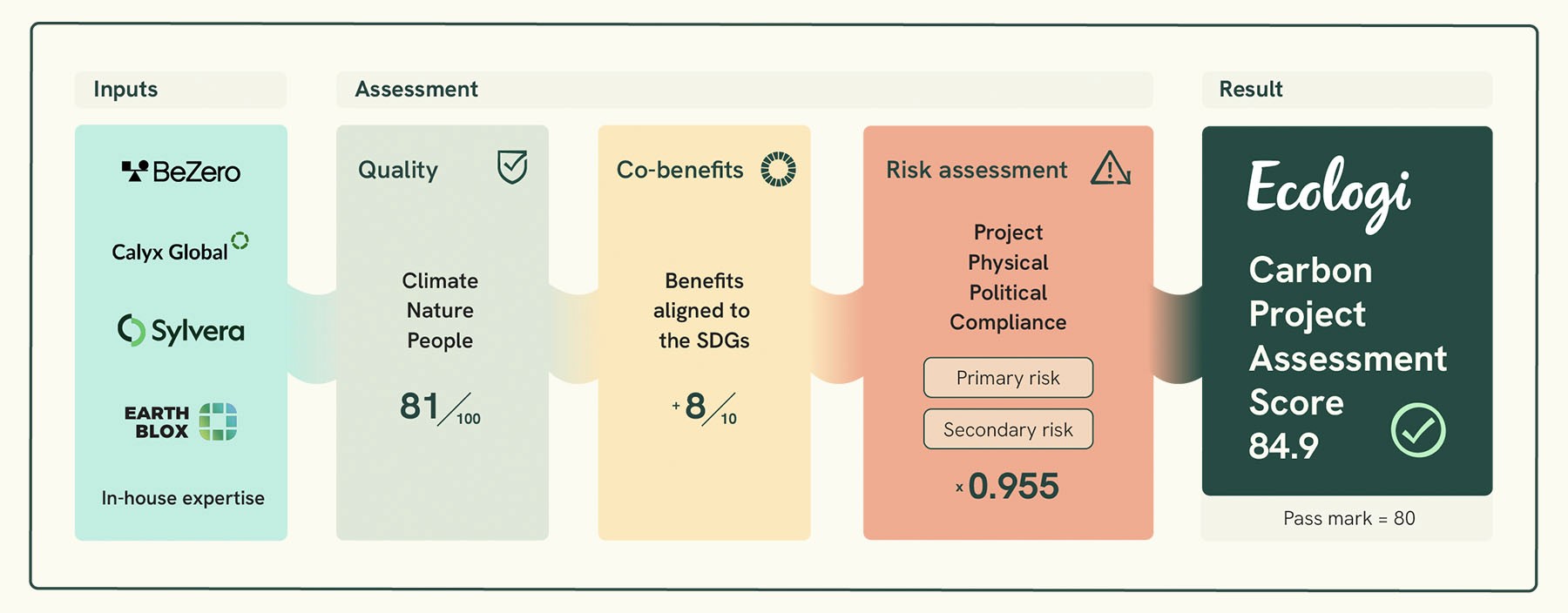
Version 2 now separates these criteria into dedicated assessment modules:

  • Quality evaluates the strength of the project's design, governance and expected outcomes.

  • Co-benefits recognise wider positive impacts across the Sustainable Development Goals.

  • Risk assessment considers the likelihood that the project – or the claims made by buyers – may not deliver as intended.

This modular approach both improves the structural readability of project assessments and makes the framework easier to develop further as new evidence and best practice emerge.

One of the most significant changes in Version 2 is a structural change which means that quality, co-benefits and risk are now assessed independently of one another.

In Version 1, these elements were combined within the quality assessment for each pillar (Climate, Nature and People). While this produced robust assessments, it made it harder to disaggregate the scores, and therefore to distinguish whether a lower score reflected weaker project quality or simply greater uncertainty.

Version 2 now separates these criteria into dedicated assessment modules:

  • Quality evaluates the strength of the project's design, governance and expected outcomes.

  • Co-benefits recognise wider positive impacts across the Sustainable Development Goals.

  • Risk assessment considers the likelihood that the project – or the claims made by buyers – may not deliver as intended.

This modular approach both improves the structural readability of project assessments and makes the framework easier to develop further as new evidence and best practice emerge.

Expanded approach to risk

Another key update in Version 2 is that risk is no longer treated as a simple moderation of quality. Instead, Version 2 introduces a dedicated risk assessment based on a Hazard × Exposure × Vulnerability risk formula. This provides a more structured way to evaluate uncertainty.

The framework also considers two dimensions of risk:

  • Primary risk – the risk that the project fails to achieve its intended outcomes to benefit Climate, Nature or People.

  • Secondary risk – the risk that buyer claims associated with the project's carbon credits could later be challenged or invalidated.

Separating out risks in these ways allows us to assess risk for a project using two lenses: one where the subject of the risk is the project itself and its beneficiaries, and the other where the subject of the risk is the buyer of the credits from the project.

Once tagged in this way, these risks are assessed across four categories:

  • Project risks

  • Physical risks

  • Political risks

  • Compliance risks

Rather than adjusting each assessment pillar individually, the risk score is applied once to the final gross (quality + co-benefits) score.

Another key update in Version 2 is that risk is no longer treated as a simple moderation of quality. Instead, Version 2 introduces a dedicated risk assessment based on a Hazard × Exposure × Vulnerability risk formula. This provides a more structured way to evaluate uncertainty.

The framework also considers two dimensions of risk:

  • Primary risk – the risk that the project fails to achieve its intended outcomes to benefit Climate, Nature or People.

  • Secondary risk – the risk that buyer claims associated with the project's carbon credits could later be challenged or invalidated.

Separating out risks in these ways allows us to assess risk for a project using two lenses: one where the subject of the risk is the project itself and its beneficiaries, and the other where the subject of the risk is the buyer of the credits from the project.

Once tagged in this way, these risks are assessed across four categories:

  • Project risks

  • Physical risks

  • Political risks

  • Compliance risks

Rather than adjusting each assessment pillar individually, the risk score is applied once to the final gross (quality + co-benefits) score.

Better recognition of co-benefits

Carbon projects often deliver benefits well beyond emissions reductions.

Version 2 introduces a standalone co-benefits module that captures these impacts more comprehensively. Rather than focusing only on the SDGs most commonly associated with a particular project type (as in Version 1), the framework now considers contributions across all Sustainable Development Goals and rewards projects for making them – even in cases where the benefit wasn’t explicitly claimed by the project.

Assessments are also more granular, using targeted breakdowns built from the SDG Targets and Indicators to better reflect the specific outcomes a project delivers. Where these contributions have been independently verified, projects receive additional recognition.

This ensures projects are rewarded for the full breadth of their positive impact while keeping those benefits clearly separate from the underlying quality assessment.

Carbon projects often deliver benefits well beyond emissions reductions.

Version 2 introduces a standalone co-benefits module that captures these impacts more comprehensively. Rather than focusing only on the SDGs most commonly associated with a particular project type (as in Version 1), the framework now considers contributions across all Sustainable Development Goals and rewards projects for making them – even in cases where the benefit wasn’t explicitly claimed by the project.

Assessments are also more granular, using targeted breakdowns built from the SDG Targets and Indicators to better reflect the specific outcomes a project delivers. Where these contributions have been independently verified, projects receive additional recognition.

This ensures projects are rewarded for the full breadth of their positive impact while keeping those benefits clearly separate from the underlying quality assessment.

Looking ahead

Version 2 of our Carbon Projects Assessment Framework (CPAF) represents a significant step forward in how Ecologi evaluates carbon projects. It makes our project assessments more comprehensive, more comparable, and faster.

As the voluntary carbon market continues to mature, we'll continue refining the framework to reflect emerging science, evolving standards and new evidence – helping ensure our assessments remain rigorous, transparent and fit for the future.

Version 2 of our Carbon Projects Assessment Framework (CPAF) represents a significant step forward in how Ecologi evaluates carbon projects. It makes our project assessments more comprehensive, more comparable, and faster.

As the voluntary carbon market continues to mature, we'll continue refining the framework to reflect emerging science, evolving standards and new evidence – helping ensure our assessments remain rigorous, transparent and fit for the future.

Is your business ready
to take climate action?

If this article has inspired your business to start its climate journey, talk to our team today.

Is your business ready
to take climate action?

If this article has inspired your business to start its climate journey, talk to our team today.

Is your business ready
to take climate action?

If this article has inspired your business to start its climate journey, talk to our team today.